


My inaugural column NAR’s AI Strategy: Why real estate associations must lobby for ‘licensee-in-the-loop’ AI laws is live on HousingWire with analysis on what NAR is doing, not doing, and should be doing on AI policy. There is no paywall, so you can read the full article for free. Real Estate Futures Blueprint message is starting to spread through media beyond the confines of this Substack.
What pleasantly surprised me is how quickly the forward-thinking leaders of our industry would move to answer the call to action
HousingWire Debut: Breaking Through the Gatekeepers
Just a month ago I was reporting on Inman’s move away from hard journalism and putting out a call for media to platform structural critiques of our industry. HousingWire answered the call and by offering me a column has proven itself as the premier destination for deep conversations about real estate, not afraid to publish uncomfortable facts and raise uncomfortable questions
Too many trade media platforms chose to play it safe, protecting vendors and defending institutional narratives at the expense of the frontline practitioner. But the demand for “real talk” is insatiable and it is going to get filled. By stepping into the breach and platforming hard-hitting policy critiques, HousingWire is showing the way on where the real estate trade media ought to be going
Status quo echo chambers just aren’t very helpful for navigating the real world
Reformer Responds: Why Jason Haber’s Outreach Matters
Within a few hours of my HousingWire OpEd publication, I received an SMS from Jason Haber, Co-Founder and President of the American Real Estate Association (ARA). Jason voiced strong support for the “Licensee-in-the-Loop” framework I proposed in my piece, noting that they have been exploring similar ideas at ARA
In the realm of real estate advocacy, there are commentators who talk about change, and there are leaders who make it happen. Jason Haber belongs firmly in the latter category. As the mastermind behind the NAR Accountability Project, Haber proved to everyone how asking the right questions could force real, lasting, historic changes at our industry’s most important institutions. Born out of the success of these initial accountability efforts, American Real Estate Association now targets advocacy growth as membership climbs toward 100,000
My piece struck a chord because it exposed a profound, terrifying legislative vacuum: the reality that without proactive advocacy action and enforcement teeth, the black-box AI models leave consumers exposed to dangerous liability, while undermining the role of the real estate professionals. With public policy makers lacking in real estate expertise, it falls to the trade groups to step up and make the case
As we talked, I proposed and Jason agreed to answer a few questions on what must be done about Agentic AI in real estate. Read our exclusive interview
The Interview: 4 Questions with ARA President Jason Haber
Here is the complete, unedited exchange with ARA’s Jason Haber on how the real estate industry must adapt to the era of Agentic AI:
On the Priorities: Should regulating autonomous AI agents be a top priority for real estate trade groups right now?
Jason Haber: It should be a priority, as long as we’re clear about what we’re protecting. The goal isn’t to regulate the technology. It’s to protect the person on the other side of the transaction. Our North Star must always be protecting what is in the best interest of our clients.
AI is going to make agents faster, sharper, and better informed, and I welcome that. What it cannot do is be accountable. AI does not have a fiduciary. A home is the largest purchase most consumers will ever make. When something goes wrong, a consumer needs a person who owes them a duty, holds a license they can lose, and answers to a regulator.
Trade groups should set that standard now, while the technology is still taking shape, rather than cleaning up after the first wave of bad outcomes. AI can do the work. But we, as industry professionals, own the outcome.
On the ARA’s Vision: How does the “Licensee-in-the-Loop” framework fit into the ARA’s long-term vision for the industry?
Jason Haber: ARA was founded on a simple idea: trading up. Raise the standards of the profession, and the public’s view of agents rises with them. A licensed, accountable professional behind every transaction is exactly that kind of standard.
Our vision of the agent is an advisor, not a gatekeeper. Clients will use more tools every year, and agents will too. And yes, that includes AI. But the relationship at the center of a real estate transaction is a fiduciary one, and a fiduciary relationship requires a fiduciary.
Licensee-in-the-loop keeps a licensed professional in the center of a transaction, protecting the best interests of a client. It’s vital that we think of licensure this way going forward.
A consumer has no idea who built a certain AI model—was it built for the best interests of the customer or for another party? The lack of clarity and the misalignment of incentives are real dangers to the consumer. This is where licensed professionals come in and, even in the age of AI, show their value.
On the State-Capital Strategy: Real estate law is governed by individual states. How do we pass effective AI laws at the state level while maintaining a unified national message?
Jason Haber: We start with a fact that often gets missed. There is no federal real estate license. No one gets licensed by the US government. Every state decides who can practice, and every state defines the duty an agent owes a client. So this was never going to be solved in Washington. It’s a question of license law, and license law lives in the statehouses across our country.
That’s also why it can be done cleanly. We aren’t asking states to write sweeping AI regulation. We’re asking them to confirm what licensing law has always enshrined. A licensed, accountable professional stands behind the transaction, whatever tools they use.
The national framework comes from the association, not from Congress. ARA can write that language once and carry it into fifty statehouses through our state leadership teams. That’s how you get unity without waiting on Washington. Our trade group wants to be the Bat Signal for the industry. I believe this is a moment when that Bat Signal needs to be flashed, and we need to get involved to address this urgent matter.
On the Consumer Shield: How do we beat accusations of “professional protectionism” by shifting the focus entirely to consumer safety?
Jason Haber: I understand the skepticism, and agents have to earn trust on this. But this isn’t about commissions. Consumers can negotiate whatever they want and use whatever tools they like. This is about who is accountable when something goes wrong.
A fiduciary owes the client loyalty, confidentiality, full disclosure, and reasonable care. Behind that duty are a license board, a disciplinary process, and a real person whose livelihood depends on getting it right. Software comes with terms of service (which, let’s be candid, most people don’t even read). A licensed agent comes with a fiduciary duty.
The law should never let a family walk into the biggest financial decision of their lives with no one accountable for it.
Call to Action: Which Trade Group Will Make This Happen?
While Jason had to keep his message focused on ARA’s own perspectives and plans, it falls to me to confront the elephant in the room:
Why hasn’t NAR adopted the “Licensee-in-the-Loop” framework for their own public policy agenda? Why not take a hard stance on autonomous AI?
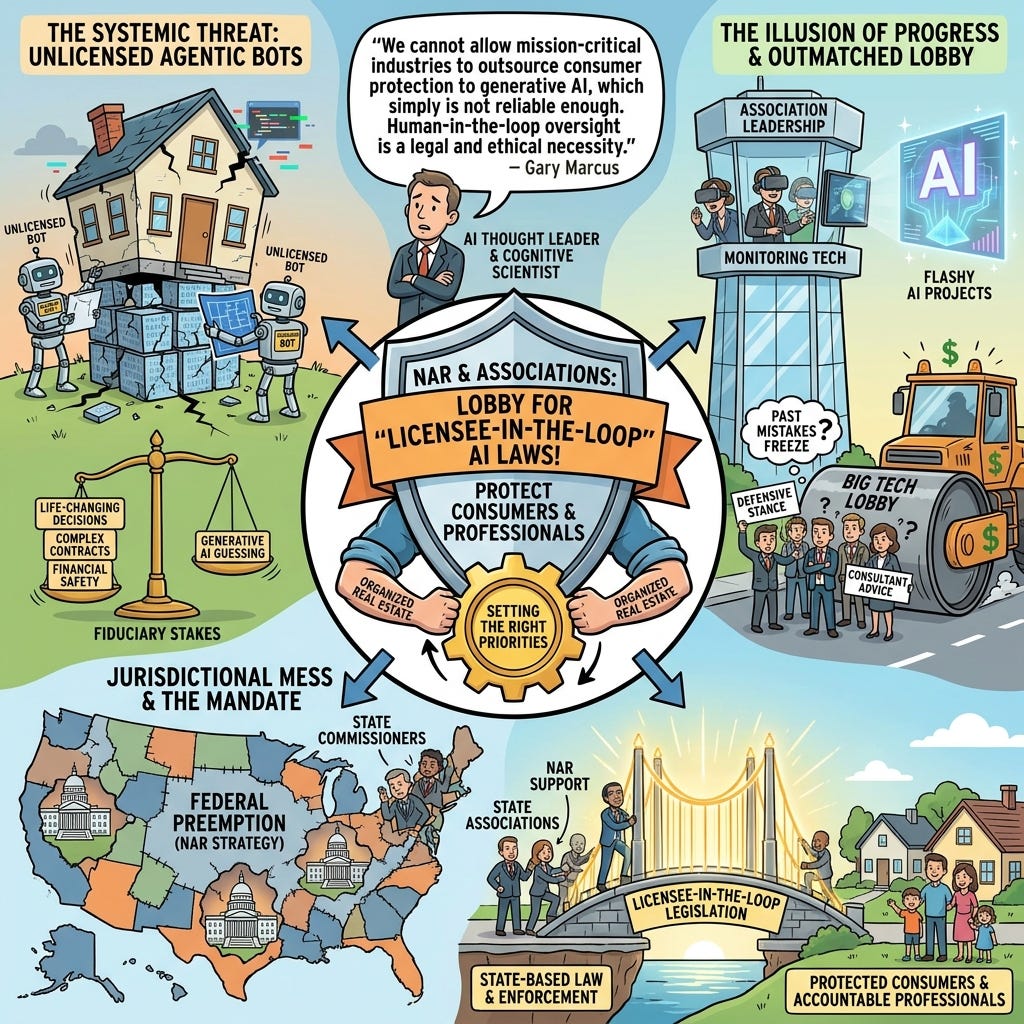
The answer lies in systemic and legal paralysis. Burdened by a multi-layered bureaucracy, never-ending regulatory scrutiny, and a historically reactive and defensive posture, our legacy leadership defaults to “monitoring” technology and “following” policy makers, over actively creating the future of our profession
To be completely clear: Real Estate Futures Blueprint welcomes positive advocacy efforts from all trade organizations, and does not take sides as they compete for membership and resources. We are just keeping our focus on protecting consumers and practitioners as the technology evolves - acting as impartial referees
The pieces are moving. The regulatory blueprint is drawn. The train is leaving the station. Who will build the future and who will lose their relevance?