

Strip away the corporate spin, the compliance theater, and the press-release fluff to assess the strategic fallout from NAR’s MLS governance revamp
When NAR announced the sunset of the MLS Technology and Emerging Issues Advisory Board at the 2026 midyear governance meeting, the real estate trade press dutifully did its job: it repeated the official talking points about "agility" "operational efficiency", "streamlining" and “nimble work groups”. No one in the traditional media stopped to ask what “problems” this structural redesign was actually meant to “solve”. No one analyzed how this radical governance shuffle exposes the association to catastrophic, compounding risks
Let’s step into the breach, look past the public relations facade, and break down exactly how this reorg will increase rather than reduce risks for NAR
Raising Alarm: Why the MLS Advisory Board Mattered
To see why the MLS Technology and Emerging Issues Advisory Board was in the way, you have to understand how it actually functioned. Historically, this panel operated as a centralized clearinghouse for the industry’s MLS and technology policy. It was a fixed, predictable, and remarkably open nexus in the policy process. For years, it maintained a formal, public feedback mechanism. It did not just receive inputs; it published the arguments, documentation, and technical briefs submitted to it by members, stakeholders and innovators. Subject matter experts could get heard
Because the Board had a permanent, publicized roster and a predictable calendar, it operated as a democratic front door. If an expert member, a technology vendor or a business innovator, flagged a critical flaw in proposed national rules, they could reach out to the Advisory Board members directly with their concerns and analysis to be heard without their perspectives being misrepresented or watered down
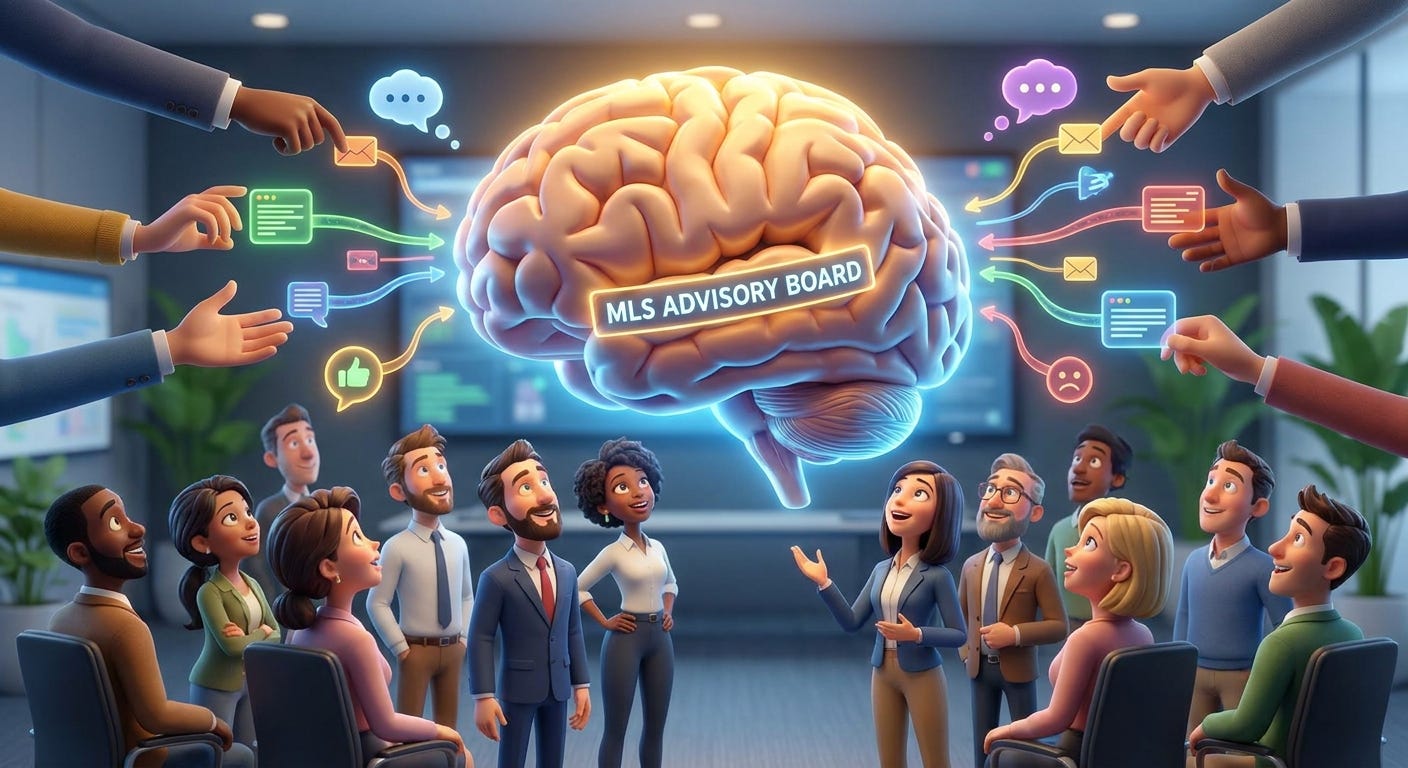
This open architecture allowed for merit and relevance to override top-down diktats. But to an executive leadership team obsessed with centralized control, any open entry point eventually starts feeling like an unwelcome headache
The irony of trying to crack down on openness is it typically ends up like welding a pressure cooker shut: pressure builds up till there is an explosion
Loss of Transparency: What "Nimble" Work Groups Actually Mean
The announced replacement structure is defined by the phrase typically heard from corporate strategy consultants hired to ram through a pre-determined outcome: “Nimble, Project-Based Work Groups”. Let’s translate this into plain English
Moving from a standing, visible Advisory Board to ad-hoc, temporary Work Groups is the structural equivalent of moving policy-making into a black box. As implied by the official announcement, a transient Work Group lacks permanent interfaces. Because these groups are created dynamically and disbanded just as quickly, there is no permanent, public roster for members to track. There is no open, standardized feedback loop. There is no publicized archive of submitted arguments or data.
By eliminating the fixed board, leadership has effectively destroyed the public petition to dominate the agenda. Members no longer have a predictable process to submit feedback to actual decision makers. Instead, policy-making is buried in the shadows, deliberately designed to operate without a paper trail, without public accountability, and without any mechanism for outside intervention
Sweeping the accountability under the rug does not make it go away
Stacking the Deck: Who Controls the Decision-Making Now
Let’s look at the mechanics of the new selection process. NAR announcement states that these temporary Work Groups will be populated dynamically by pulling names from an internal, staff-curated “expertise database”
This is where the illusion of “agility” meets the reality of control. Who defines the criteria for “expertise”? Who decides which names are even considered and who makes the final decisions on the specific individuals admitted to a given group? So far this looks like an entirely top-down selection process controlled by leadership and staff, showcasing all the systemic problems I broke down in our foundational post on “The Governance Audit: Study of Systemic Flaws”
To be fair the MLS Advisory Board was never a “Jeffersonian Democracy”, however it provided a mechanism for open feedback with potential to influence outcomes. With the new setup the NAR Leadership can secretly hand-pick an ad-hoc echo chamber, stack it with friendly insiders who already favor the pre-determined outcomes, and secure a swift, frictionless rubber stamp, without bothering to openly hear any concerns, counterpoints or suggestions. This kind of closed-door governance strips the institution of its legitimacy in the eyes of the membership, just while NAR is still striving to recover from the scandals and the lawsuits
As Comrade Stalin famously described his top-down control: "Cadres decide everything" — and that is exactly how the new NAR playbook looks
Flying Blind: The Legal Risks for NAR and Its Members
NAR leadership might claim that this restructuring reduces liability by shifting controversial decisions to local MLS level and insulating national bodies from antitrust scrutiny. The reality is precisely the opposite: this new architecture creates different kinds of exposure for NAR

First, by deliberately blinding themselves to outside feedback, these hidden Work Groups will inevitably suffer from institutional groupthink. When you lock out the full range of voices, you are going to miss unintended consequences of the proposed policies. You can fully expect that new rules may contain fatal, unforeseen flaws— leaving them open to unexpected challenges from outside. A great recent example of flawed groupthink by CAR’s closed-door SPF Committee is covered in my recent piece: ”Organized Real Estate Struggles to Address AI Disruption”
Second, to expand on the idea of secretive process undermining legitimacy, the fallout may go beyond mere public relations, and into the territory of challenges to the governance process itself. As I highlighted in “The Governance Audit: Study of Systemic Flaws”, REALTOR® Associations and most MLSes are structured as membership non-profits, with the interests of regular members being paramount under the state laws. An opaque secretive process that fails to credibly represent the membership’s will may be a ripe target for a challenge. I’d leave it up to anyone’s imagination to picture how a challenge to institutional legitimacy may play out
Secrecy does not make liability go away, the liability is just going to morph
Reclaiming the Floor: A Demand for Open Governance
If NAR Leadership truly believes that this shift to ad-hoc Work Groups is about modern efficiency and maximizing expertise rather than a closed-door consolidation of power, the solution is exceptionally simple: prove it with action
We ask NAR Leadership to publicly refute this narrative by implementing three basic principles for the new Work Groups:
Publish the Complete Rosters: Make the criteria, selection process, and current rosters of every established Work Group fully transparent and accessible to the general membership
Open the Digital Floor: Establish a permanent, public, and unfiltered digital portal where any member or industry stakeholder can submit technical and legal inputs directly to any active Work Group
Log the Inputs: Guarantee that all agendas, minutes, and submitted member arguments are published transparently, showing exactly who influenced the policy, why, and how
The industry is watching closely. I encourage NAR Leadership to show how the new Work Groups will represent the members. Prove me wrong