

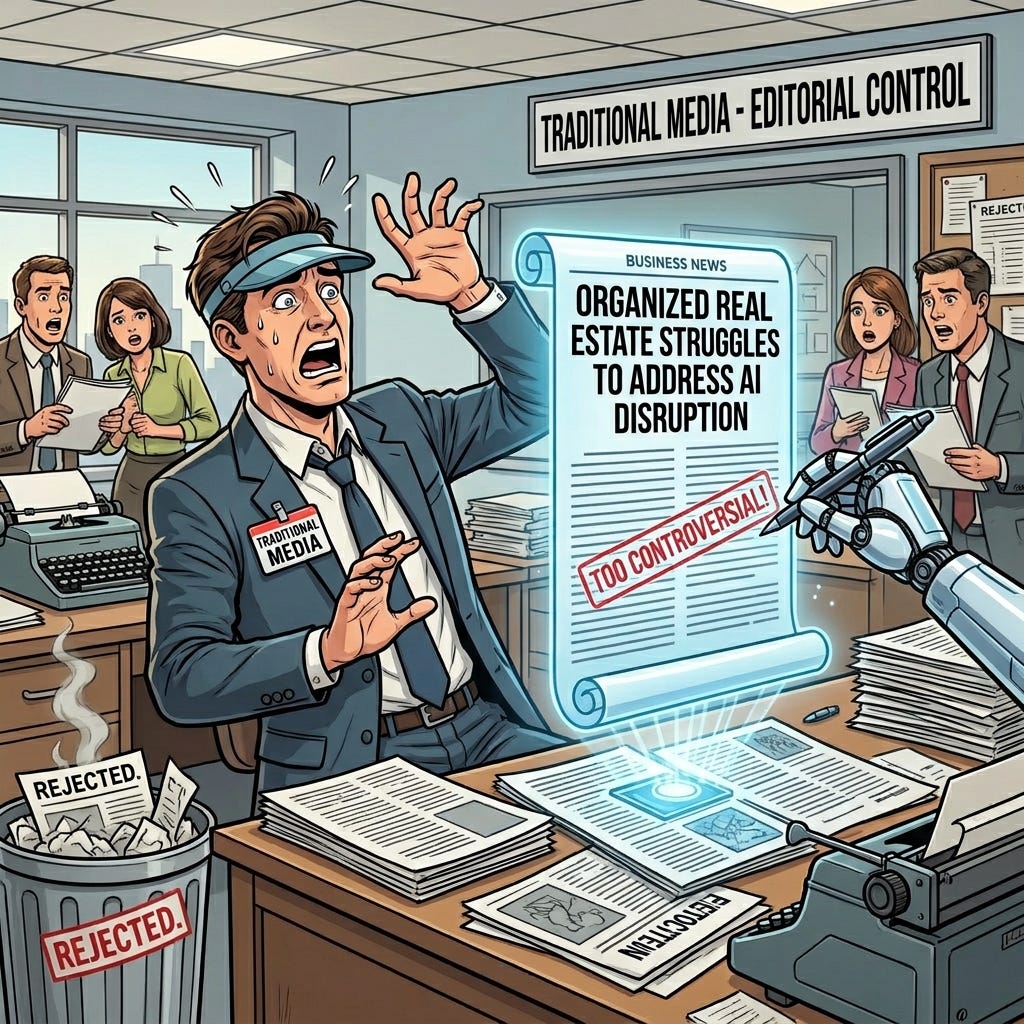
Editor’s Note: This article was originally drafted as an exclusive Op-Ed for a major real estate trade publication. It was rejected as “not the right fit”. When the established industry media chooses to look away from uncomfortable structural realities, the Real Estate Futures Blueprint steps in to deliver the unvarnished truth. A closer look at the state of our industry media is coming soon
The real estate industry faces an existential threat in the rise of Agentic AI, yet our institutional response is being crippled by a profound governance disconnect. Rather than leverage the frontline expertise of our membership to forge a proactive path, leadership has retreated into a posture of dangerous complacency, outsourcing our strategic future to external corporate consultants who lack the fiduciary perspective of the working practitioner. This reliance on detached, top-down decision-making is undermining the very professional standards we are sworn to protect
The Cost of Outsourcing Our Future
The lack of open and collaborative policy-making debate allows flawed strategic directions to take root without necessary professional scrutiny. This trend was illustrated during the Strategic Planning and Finance (SPF) Forum (link access restricted to CAR Members) at the recent California Association of REALTORS® (C.A.R.) 2026 Spring Meetings in Sacramento. Leadership presented a roadmap for an AI-enabled future that was heavily driven by an external corporate consultant rather than the practical experience of the membership grassroots
This creates an immediate conflict: a consultant sells a digital vision, while the practitioner bears the full weight of professional, ethical, and legal liability
In a slide titled “Future Seller Expectations” the consultant heavily downplayed the future role of the real estate agent, conceding wide swaths of the professional’s job description to algorithms. In a particularly notable example, attendees were explicitly told that helping a seller price a home competitively will no longer differentiate an agent. Why? Because “AI pricing tools are fast and free” and will simply become an “expected baseline service”, as you can see in the slide screenshot below
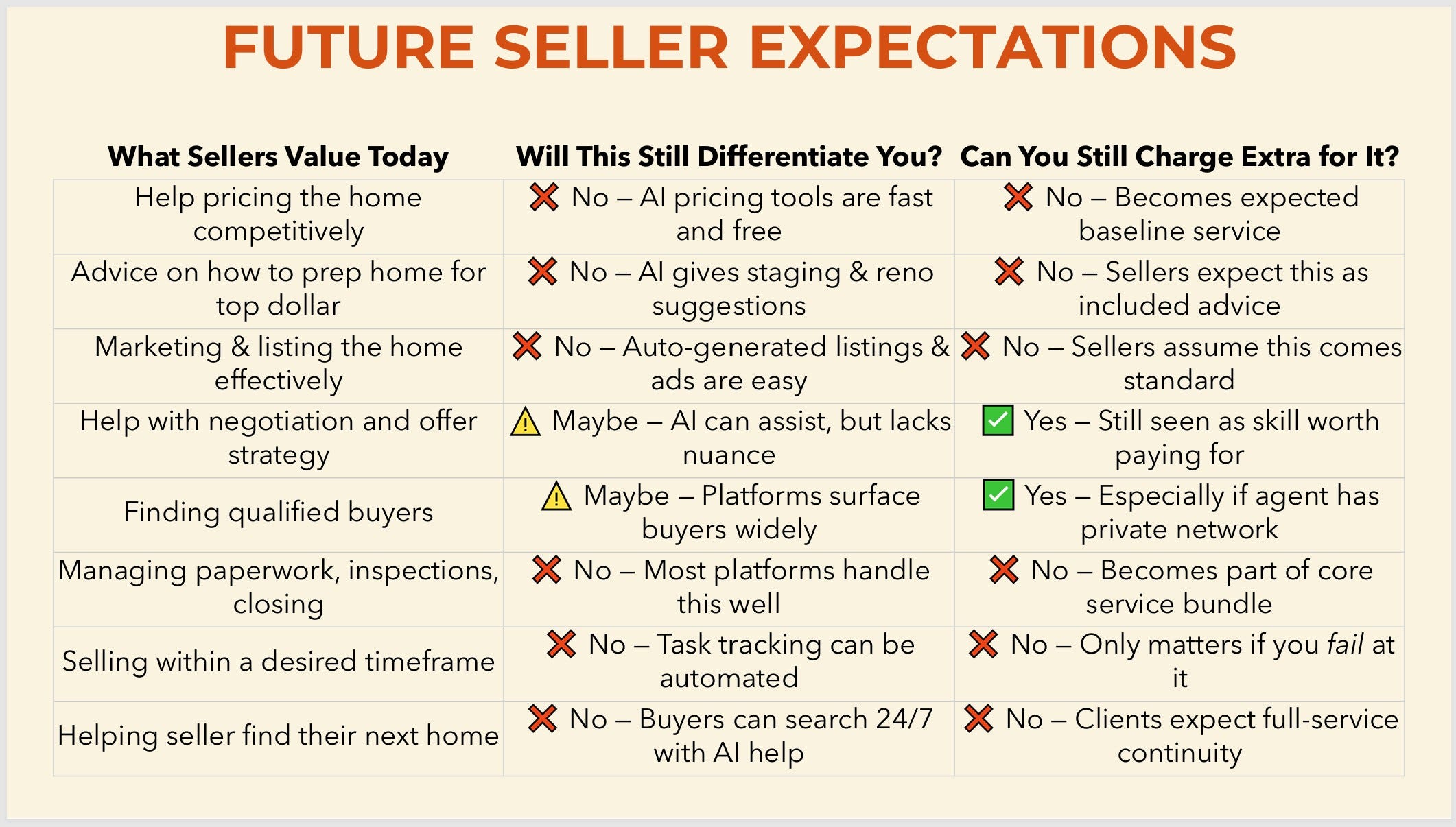
The SPF Committee, in a closed session with the consultant, did not question the notion of AI supplanting most of the real estate agent’s value. Instead they greenlit his presentation to go before the SPF Forum in Sacramento. While the presentation itself painted a rosy picture of AI-driven future, barely acknowledging the challenges to be solved, ironically the questions from the floor pointed out plenty of the real world concerns with deployment of the technology
As a software engineer turned real estate broker, I must sound an alarm
Why Algorithms Can’t Replace Fiduciary Duty
Ceding property pricing to an algorithm is a dangerous surrender of our professional value. While AI can aggregate public data and compile historical trends at lightning speed, it suffers from a fundamental “black box” problem. Algorithms do not walk through a property. They cannot smell a damp basement, assess the quality of a recent renovation, or understand the hyper-local nuances of why one side of a street commands a premium over the other
Moreover, AI has a tenuous grasp on strategy. Pricing a home is a delicate balancing of market sentiment, buyer psychology, and a seller’s unique financial goals. AI can shovel data, but it completely lacks fiduciary duty and the accountability that goes along with it. An algorithm cannot be held legally or ethically accountable for hallucinating a material fact, leaving a client’s equity on the table, or presenting flawed advice based on incorrect information. This top-down prioritization of digital efficiency and control illustrates the deep structural perils we broke down in The Governance Audit: A Study of Systemic Flaws
When our leadership relies on corporate tech consultants—who lack hands-on practical experience as clients’ fiduciaries—they inevitably sacrifice the physical, emotional, and fiduciary realities of real estate at the altar of digital efficiency
Imagine what may happen if such strategic miscalculations actually turn into policy priorities, resource allocations, and legislative agendas
This failure to confront the existential threat of Agentic AI is not localized to California. The Regulatory Issues Forum held at the 2026 NAR mid-year conference was a similar display of institutional complacency. Instead of clearly advocating for direct regulatory oversight of Agentic AI to counter dilution of the real estate licensee role, NAR representatives seemed to concede the policy agenda to the invited speakers. At the time when unlicensed autonomous bots are already entering the market to perform licensed real estate activities, the industry’s advocacy infrastructure is reacting with delays, confusion and excuses rather than decisive policy action directed to secure the value of the human licensees

The Governance Disconnect: Gatekeepers vs Grassroots
How does an industry as vast and localized as ours ends up adopting flawed policy directions from secretive committees? We are witnessing a fundamental disconnect between the top-down governance and the street-level practitioners
As if to acknowledge the imperfections, NAR Leadership has recently recognized that the old ways of governing are failing by sunsetting numerous committees, and the CAR Board of Directors in Sacramento approved hiring consultants to perform a comprehensive governance review, for the first time since 1990. The irony should not escape us: leadership is turning to yet another group of outside consultants to patch up a governance system led astray by reliance on outside consultants
While these steps are encouraging, the real question is whether they translate into true, member-centric reforms or will remain purely performative
The era of small, closed-door committees dictating the future of our profession must end. If we are to survive the “Netflix moment” of Agentic AI, we must reform our policymaking from leadership-first gatekeeping to member-first empowerment. We need a new blueprint for industry decision-making—one that harnesses the grassroots intelligence of everyday agents, amplifies their voices, and holds our institutions accountable. The future of real estate won’t be secured by secretive committees; it will be reformed by the membership grassroots
A Movement for Member-First Governance
If you are a practitioner, a broker, or an industry innovator who believes our future must be built on human fiduciary oversight and transparent governance, it is time to speak up and join the movement for reforming our industry institutions. Our industry needs an open policy debate as we face the monumental technological shifts driven by AI. Our policy solutions and our collective advocacy resources must support the needs of consumers and professionals, rather than be shaped behind the closed doors with no accountability for outcomes. Take charge of your livelihood!