

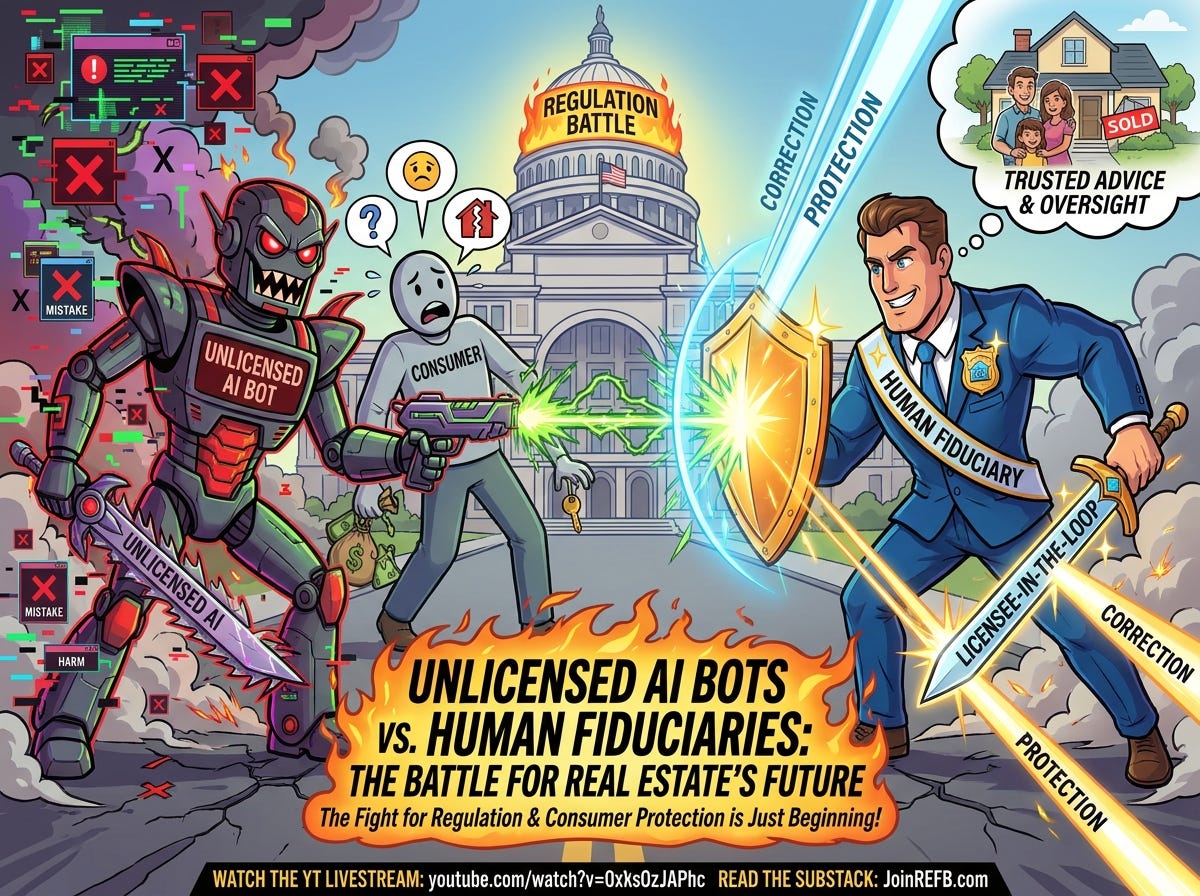
Let’s take a breather and assess the political landscape for regulating Agentic AI in real estate. I have been beating the drums of this problem publicly since launching Real Estate Futures Blueprint this summer, starting with my inaugural “Worthy Cause” post that shared my Licensee-in-the-Loop Whitepapers, which had been circulated privately for over a year earlier. As of now there are lots of new facts to explore
Licensee-in-the-Loop Panel: Livestream with Jason Haber & RLTYco
Last week, I took part in the public discussion of Agentic AI in real estate. This was a roundtable YouTube livestream on The State of Real Estate hosted by Jason Haber and the RLTYco team. This panel matters because it is the very first time Agentic AI problems and solutions in real estate have been debated publicly and openly.
If you can make time, I highly recommend listening to the entire livestream
Quick Summary: We focused on the core problems with Agentic AI. It is not like regular ChatGPT or Claude where you type a question and get a single answer back. Agentic AI stands for smart AI bots that can do things all by themselves in a continuous loop. These bots can browse the web, find houses, talk to buyers / sellers / agents, and handle transactions end-to-end. The scary part is that there are already companies doing this for compensation without holding a real estate brokerage license. They perform a human agent’s job without any guardrails or oversight.
The livestream revealed that the lobbying push to put a stop to these illegal activities is already underway. Jason Haber, the President of the American Real Estate Association (ARA), is showing true leadership. While traditional professional organizations wait for tech vendors and consultants to tell them what to do, Haber has already shared a written “Licensee-in-the-Loop” proposal directly with state legislators in New York for their upcoming session next year.
This legislative push is moving forward state by state. This is underway, regardless of what the traditional associations decide to do or avoid doing
Deflection in Long Beach: Inside the NAR Directors Forum
To really understand why these legacy institutions need drastic reforms, we have to look no further than the NAR Directors Forum at the California Association of Realtors (CAR) meetings in Long Beach that happened earlier this month.
BTW, my main report from Long Beach is up on HousingWire to be covered later: “CAR Governance Review sparks debate over member access and control”
At the NAR Directors Forum, open to all CAR members, I stepped up to microphone to ask NAR President Kevin Brown to comment on my interview with Jason Haber and ARA’s commitment to lobby for AI regulation. In front of the ~100-200 or so top leaders in California real estate I invited Kevin to share any plans for confronting the Agentic AI dangers that NAR might be considering
Instead of directly responding to the clear threat of unlicensed AI bots, President Brown replied with deflection. His main point was to de facto question whether ARA has sufficient capabilities to be a player in lobbying. In a later response to my email request to verify the understanding of our exchange he stated that he merely asked the audience whether ARA is in fact a registered lobbyist in all the 50 states
This exchange draws a sharp contrast between two completely different worlds
On one side, NAR President is focused on who said what instead of actually addressing the issue. On the other side, an upstart trade group is jumping on a livestream to talk about a ready-to-go bill already on the desks of state lawmakers in New York. You be the judge of who is moving our industry forward.
While it is undoubtedly true that ARA’s resources are limited, the right response from the traditional associations should be collaboration over defensiveness
NAR’s Maginot Line: Stuck in the Past While the Future Knocks
Recognizing that an off-the-cuff question from the microphone may have caught Kevin unprepared I followed up with an official press inquiry to NAR’s leadership. To set the record straight I offered an opportunity to state their official plans exactly as they want to phrase it. For the record, here is the exact question I posed:
Question: “What is NAR’s position on, and plans for, sponsoring or supporting state-level legislation designed to enforce direct human licensee oversight over autonomous Agentic AI systems in real estate?”
Despite being given a clean policy question with 2 business days (plus weekend) to respond, NAR missed the publication deadline. They stayed completely silent, aside from Kevin’s earlier email clarification of our exchange at NAR Director Forum. What does it say about our premier trade organization to have no comment about handling the biggest technology shift in history? They are stuck in the past leaving both the general public and the professional community unprotected
Next, I must note that NAR has already acknowledged Real Estate Futures Blueprint as a legitimate industry publication by providing an on-the-record quote for our earlier “Sunshine Manifesto“ piece. The difference is their earlier response, while failing to address the direct question, at least had prior press statements to quote
Yet on Agentic AI, apparently NAR has nothing to say, and their stance mirrors the famed piece of military history called the Maginot Line
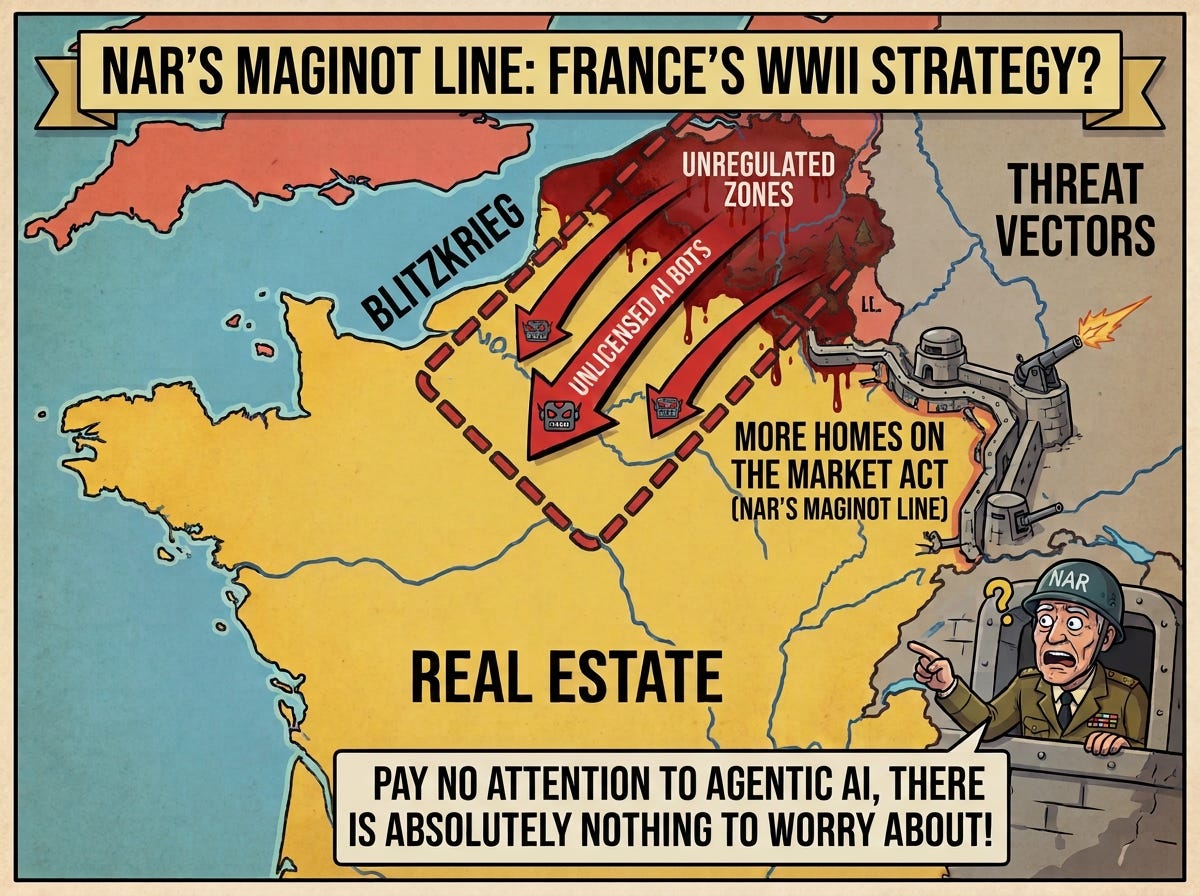
NAR is putting all the money and power into traditional supply-side lobbying, like the More Homes on the Market Act. This sounds much like how the French prepared for WWII. They built a massive, incredibly expensive concrete wall to face an old threat. They were completely blind to the fact that the world has changed and now the tank armies could easily bypass their fixed fortifications through the Ardennes forest. The France fell in 1940 to the new military doctrine of blitzkrieg and the rest is history
Agentic AI is a blitzkrieg unfolding right before our eyes in every industry and NAR is yet to state any kind of position, let alone any real plan to address it
Symptom vs. Cause: The Anatomy of the Institutional Failure
This failure to protect consumers and professionals from unlicensed AI threat is not an accident. This is a direct symptom of an outdated, top-down institutional structure that values inertia and getting along over proactive focus on the future.
The legacy leadership is culturally coached to protect status quo over embracing the change happening in the real world: till the problems become acute
In particular, a key source of hesitation in pushing to legislate Licensee-in-the-Loop is the position of large brokers overseeing hundreds or thousands of agents. These brokers are terrified of having a real conversation about modernizing “broker supervision rules” for the brave AI world, because it opens a broader debate over what constitutes the role of the licensee and the supervising broker. In the practical terms of institutional politics just a few voices like that whispering in “smoke-filled rooms” are often enough to freeze any meaningful debate. However such debate is necessary and should focus on reimagining the role of brokerage in the age of AI, balancing the issues of broker liability vs broker margins vs broker automation
To address the institutional sickness, we must confront the root cause. Organized real estate needs a grassroots reset where actual members are put in the driver seat over unelected insider elites. Members need to be empowered to drive agenda through binding votes rather than inconsequential surveys. Frontline professionals must take charge of their institutional governance at local, state and national levels, and there is a wide range of tools for putting such ideas of member control into practice
The organized real estate infrastructure has been paid for by member dues over decades. A calibration is in order to make it work for the members
Conclusion: Direct Democracy for Frontline Professionals
The time has come to examine how the millions of dollars in member dues are spent across the country and put frontline practitioners into the driver seat
We must replace traditional ways to obscure decision-making and manufacture consent with direct democracy. Every single association office, every dollar of every budget, and every political campaign priority needs to be driven by binding voting of the general membership. There is no excuse for agendas and framing dictated by unelected elites behind the closed doors at the expense of common cause. While the failure to act on Agentic AI is the most glaring example, there are plenty more
Let the irony sink in. While ARA is stepping up to lead Agentic AI lobbying push with very limited resources, the traditional trade associations are withholding their political heft - without asking members. This situation is nothing short of untenable
Implementing a “Member-First Reset” won’t happen overnight and will require a mix of interdisciplinary tools: political, legal, and technological. We are just at the beginning of this journey and the destination will be well worth it
Time to turn on the light, step out of the shadows, and take control of the future