

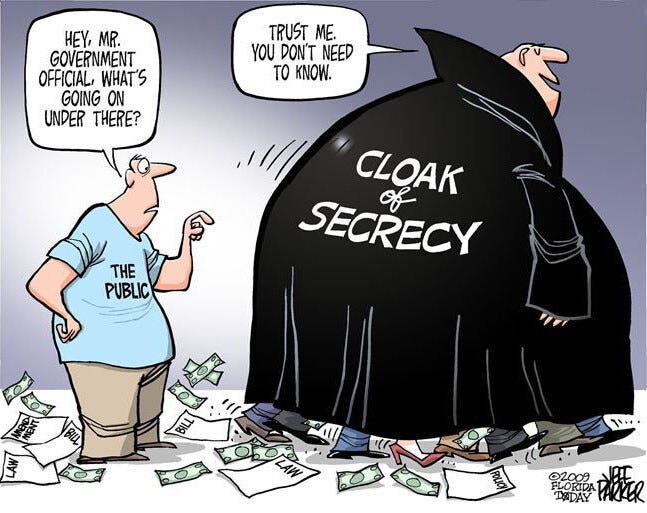
Presenting a framework for transparency in organized real estate
My recent post Death of Transparency: NAR Disbands the MLS Advisory Board kicked off the conversation on institutional transparency, followed by cultural diagnostic in Leadership Culture: Why Organized Real Estate Struggles to Adapt. To continue conversation I posed my 3 questions about dismantling public feedback mechanisms to NAR as on-the-record press inquiry. The outreach was addressed to NAR’s MLS Policy Staff with the entire NAR Leadership Team copied on cc
NAR Responds: My Press Inquiry on Transparency
To NAR’s credit, Raffi Williams, VP of Communications replied within a tight four-day window with a formal response
First of all, I would like to thank NAR for de facto validating Real Estate Futures Blueprint as a legitimate media platform and industry watchdog, just a month after our public launch. With that said, the response looks like typical PR boilerplate, that fails to actually address my questions and demonstrates that NAR has a lot to account for. To be fair, I appreciate the engagement and recognize that actually implementing true open governance might take a little bit longer than a couple days
Here is NAR’s formal response to my 3 transparency questions:
As laid out in NAR’s 2026-2028 Strategic Plan that was adopted by our Board and is the roadmap for our work over three years, NAR can, and does, convene workgroups to enable us to be more nimble and responsive to member and industry needs. Our current MLS workgroup, made up of a diverse set of MLS executives and brokers of all sizes, is doing just that with the help of outside experts from around the industry who bring unique and valuable perspectives to the workgroup. Recommendations will go through NAR governance, including the Multiple Listing Issues and Policies Committee. The MLS Committee meeting at NXT is open for interested members to attend. Any member who is interested in shaping MLS policy is encouraged to fill out an application and apply to be on the MLS Committee. This year, we improved the application process to ensure committee members have the right experience and expertise.
For additional information please read the op-ed written by the 2026 MLS Technology and Emerging Issues Advisory Board Chair. Below is a portion that is relevant to your request:
“The MLS Issues and Policies Committee will assume the work of the MLS Technology and Emerging Issues Advisory Board, and the committee will assemble ad hoc working groups as issues emerge. These groups will be issue-driven and responsive to real-time market dynamics. It’s the right model to gather the right expertise at the right time, ensuring MLS-related developments continue to receive focused, timely attention without interruption.”
“The new expertise profiles NAR introduced in this year’s committee application process allow committee leadership to better tap into members’ knowledge. These profiles serve as an expertise database where we can quickly identify niche proficiencies across a variety of skilled and engaged NAR members. Specifically, the MLS Issues and Policies Committee leadership will now be able to tap into current members, known issue experts, and this broader data set to assemble the most qualified group of advisors.”
This is a classic corporate non-answer. Stripped of the executive buzzwords, NAR explicitly admits that permanent, transparent panels are being replaced by ad-hoc, invite-only “workgroups” hand-picked from a hidden “expertise database”. They have formalized the transition from a representative membership democracy to a curated, closed-door technocracy.
I have applied for NAR’s MLS Committee multiple times in the past and watched seats consistently awarded based on political tenure and “career path” rather than any specific insights. Once these committees finally meet in an “open session” at events like NAR NXT, there is no real debate. Everything is pre-determined behind closed doors, with the public meeting being merely a rubber-stamp theater. To put this new “expertise database” to the test, I formally applied for the NAR MLS Committee in this current 2027 appointment cycle. I am not holding my breath and fully expecting to be rejected for not fitting into the pre-determined mold, despite being a Cornell-trained computer scientist and innovating broker at the same time.
The reality completely undercuts the Inman News puff pieces, such as the September 1, 2026 article titled “NAR has written the roadmap: Are Realtors down for the ride?”. No, not really, not when the roadmap leads straight into a black box. True transparency means allowing all members to participate as the sausage is being made, not just being invited to watch a rubber-stamping ritual.
Now that we’ve dispensed with the status quo theater let’s look at solutions
"Brown Act" Basics: Demystifying California Sunshine Laws
To understand how we fix this, we must look at how public governance solved the exact same human problem. In 1952, San Francisco Chronicle reporter Mike Harris published an exposé revealing how local city councils and school boards were using “study sessions,” “workshops,” and “informal caucuses” to hammer out political deals in secret before holding scripted public votes. Their excuse? They claimed they needed to be “nimble” to handle complex issues efficiently. Sound familiar?
In response, the California Legislature passed the Ralph M. Brown Act of 1953. It was not designed as dry legal bureaucracy, but as an elegant accountability guardrail that added enforcement teeth over time. The law is built on a profound philosophy codified in California Government Code § 54950, and written by Mr. Harris himself:
"The people of this State do not yield their sovereignty to the agencies which serve them. The people, in delegating authority, do not give their public servants the right to decide what is good for the people to know and what is not good for them to know."
The Brown Act established core pillars that modern citizens now take for granted: mandatory advance public notices, unredacted meeting minutes, and an open floor for public debate before any vote is cast. It recognized a fundamental truth: transparency isn't about the final vote; it is about the deliberation. If the real discussions happen in hidden workgroups, the formal voting meeting is nothing but political theater. The Brown Act legally defines a "Public Body" to ensure that any group wielding collective authority must answer to the people who fund it.
To go deeper on how this works in practice, refer to the authoritative California’s Brown Act: Clearing the Smoke-Filled Room scholarly article
Quasi-Government: Why a Trade Association is a Public Body
Organized real estate institutions love to emphasize the legal status as “private trade associations” or “private non-profits” to justify secrecy. But the “voluntary club” status is nothing but an illusion. Because professional associations and MLS entities wield massive, near-monopoly control over the livelihoods of real estate professionals, they operate as “Public Bodies” in everything but name.
California has already established the legal precedent for expansion of open governance requirements to private non-profits. In 1985, the state passed the Davis-Stirling Act, extending strict open-meeting sunshine laws to Homeowner Associations (HOAs). Why? Because HOAs possess quasi-governmental powers: they can tax members through mandatory assessments, issue fines, and dictate rules enforceable over property owners. The state demanded they post advance agendas, keep open archives, and maintain open member forums.
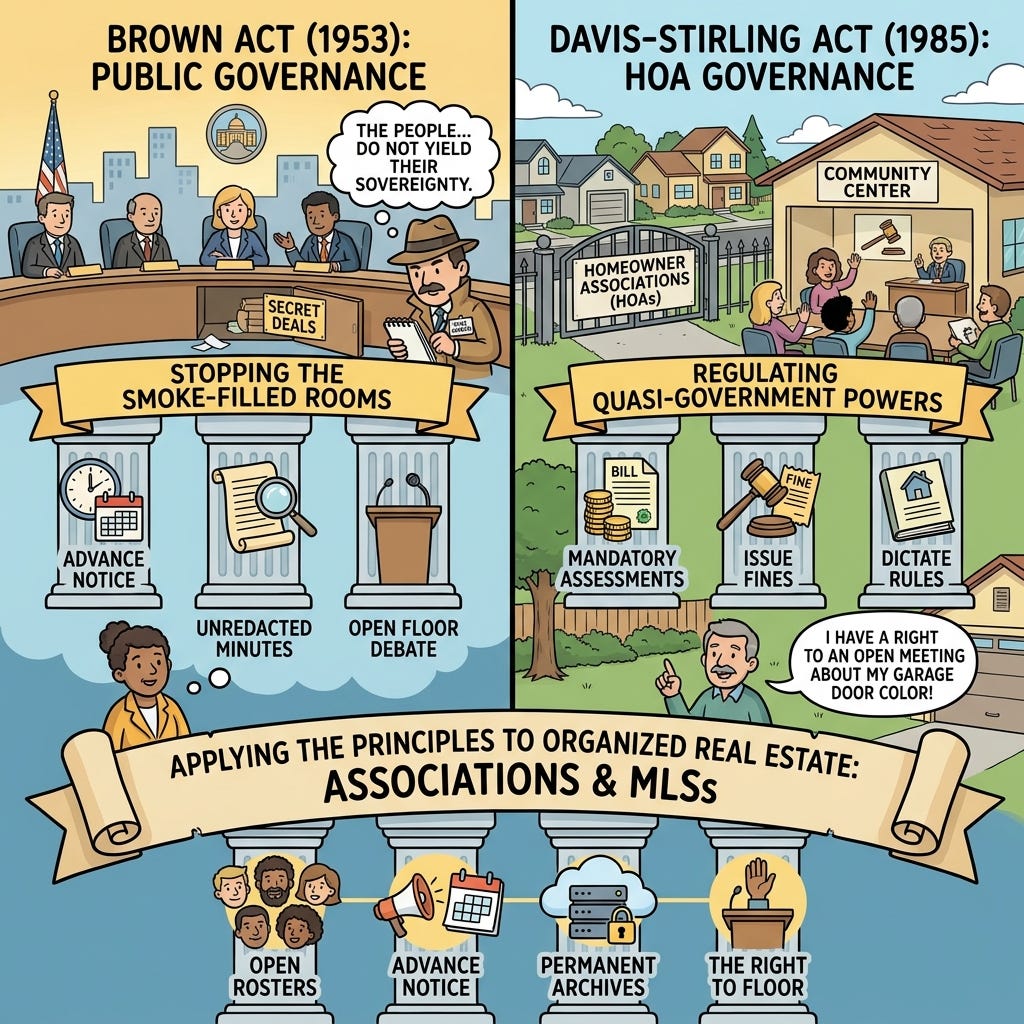
Extending this identical logic to REALTOR® Associations and MLS boards is the next logical step in real estate governance. To clarify: when we say “Public Body” in this context, we are not talking about opening everything to the general public. We are referring to the internal transparency and shareholder democracy for the dues-paying membership, exactly like this works with HOAs.
If an MLS workgroup secretly crafts a proposal altering technology standards, cooperative rules, or data access policies, this could directly affect the agents’ ability to feed their family - without providing any opportunity to weigh in. Just like a homeowner having a statutory right to an open meeting because an HOA regulates their garage door color, a dues-paying real estate professional must have an absolute right to open meetings when an association regulates their economic survival.
Not allowing all dues-paying members a direct say in all Association and MLS policy matters is tantamount to “taxation without representation”
The Roadmap: Implementing the "Brown Act" in Real Estate
Now let’s take the abstract principles of open governance and permanently hardwire them into our institutional bylaws. This structural standard needs to be applied universally to all National, State, and Local Associations, as well as all MLS organizations—regardless of whether they are structured as membership non-profits, board-driven non-profits, or even regional for-profit entities.
In my Death of Transparency post, I outlined three key questions that NAR has not addressed in their reply to my inquiry. Synthesizing them with the mechanics of the Brown Act and Davis-Stirling Act yields four key pillars for real estate governance:
Open Rosters: Any group, task force, or panel assembled to recommend changes to MLS policy, technology standards, or member policies or rules must have a public roster and a fixed, visible interface (no hidden workgroups). The era of hand-picked, anonymously formed advisory databases must end.
Advance Notice: No policy can be altered, debated, or voted upon without a clear, public agenda posted to the membership portal reasonably in advance, complete with electronic subscription feeds for instant dissemination to all interested members. Members must have the right to know and weigh in
Permanent Archives: All public decision-making panel debates, feedback submissions, and supporting materials must be logged and preserved in a permanent, unredacted, accessible and searchable digital archive — not dissolved or wiped out when a temporary workgroup finishes its task.
The Right to Floor: Dues-paying members must have the absolute rights to observe all deliberations, with any exceptions defined very narrowly and specifically. We must mandate remote live engagement (via Zoom or similar) to open the floor to members unable to travel to state or national conventions. Furthermore, we must eliminate "Chair's Privilege" — a tool routinely used by leadership to block non-committee members from speaking. Every member must have a guaranteed right to speak at any policy-making meeting.
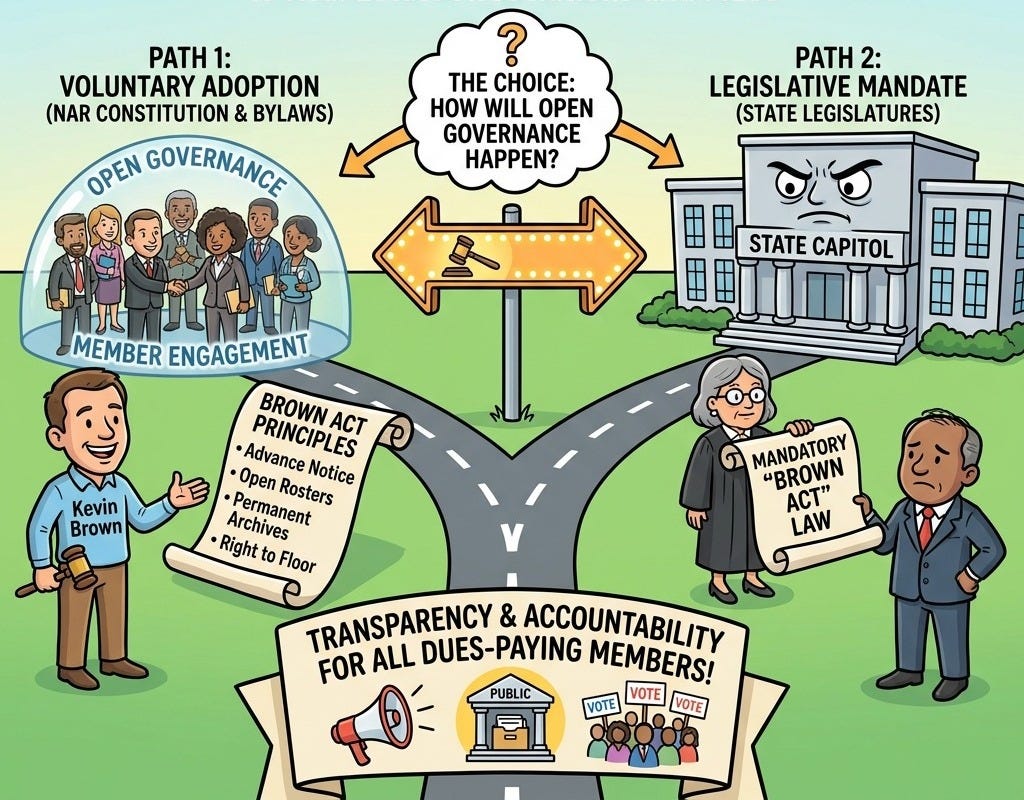
While the Brown Act and Davis-Stirling Acts were imposed by the California legislature top-down, organized real estate institutions have an opportunity to demonstrate their commitment to transparency and member rights by voluntary adopting such principles into their corporate bylaws
Ironic Echo: Will Kevin Brown Support the "Brown Act"?
The ultimate test of leadership is now. At the moment of this writing, the 2026 NAR President happens to be Kevin Brown. The historical irony is too sharp to ignore: as organized real estate continues to struggle with institutional legitimacy.
This presents a defining choice to establish the legacy. Will President Brown’s administration be remembered for presiding over replacement of the MLS Advisory Board with ad-hoc black boxes — or will he choose to champion an industry-wide “Brown Act” that codifies transparency into our national bylaws?
The era of the black box governance must end. We need this to become our national standard for every single Association and MLS in America. This is how healthy, trusted, and legitimate professional institutions must operate.
I invite the entire spectrum of stakeholders — solo agents, team leaders, independent brokers, MLS executives, and reform-minded association leaders — to weigh in on these ideas. Your feedback, concerns, and structural insights will shape the mechanics of the transparency and engagement initiatives for years to come.
The question is whether NAR will step up to codify “Brown Act” principles into NAR Constitution & Bylaws or wait for state legislatures to take action